01
What each movement cost.
Thrusters, pull-ups and the run scored separately instead of averaged into one number. You will recognise the one that is eating your score.
Vitroo band — signal
Every other tracker watches your heart rate and calls it functional strength training. Vitroo knows there were thrusters — so it can tell you what each one cost, how fast you came back, and where the round fell apart.
From ¥59/month · band included · cancel anytime
4
training axes scored on every session
8
HYROX stations, each scored on its own
21days
on a charge, so charging is a monthly errand
9,763
boxes on the map, every one of them searchable
01 — The problem
Forty-one minutes. Average 154. Peak 183. That is what every tracker on the market hands you after a hard session — and it is equally true of a Fran, a heavy back squat day and a bad night of sleep.
It cannot tell you the thrusters emptied you and the pull-ups were fine. It cannot tell you round three cost forty seconds more than round one. It never knew there were thrusters, because it was never told — and it can't ask, because most of the people wearing it aren't doing a workout at all.
02 — What it measures
A session is genuinely several things at once. A HYROX piece is running and mixed endurance. A heavy day with an easy finisher is strength and recovery. Forcing one winner throws that away, so nothing here forces one.
Running
Monostructural work — run, row, ski, bike, swim. The engine, measured on its own rather than averaged into the session it appeared in.
Strength
External load, plus half of gymnastics. Bodyweight strength counts — it is still strength — but not at the same rate as a loaded bar.
Endurance
How blended the session was. Highest when running, gymnastics and weightlifting are even — a true metcon — and zero when one of them owns the hour. A shape, not a volume.
Recovery
Your own effort rating, inverted. Present only on the sessions you rated, and absent on the ones you didn't — never guessed, never filled in with a zero.
Under the axes sits the classic split — monostructural, gymnastic, weightlifting — read straight out of what you wrote down. No two axes are the arithmetic inverse of each other, which is the difference between a radar that says something and one that see-saws.
03 — How it works
One thirty-second habit before you start is what makes everything afterwards possible.
01
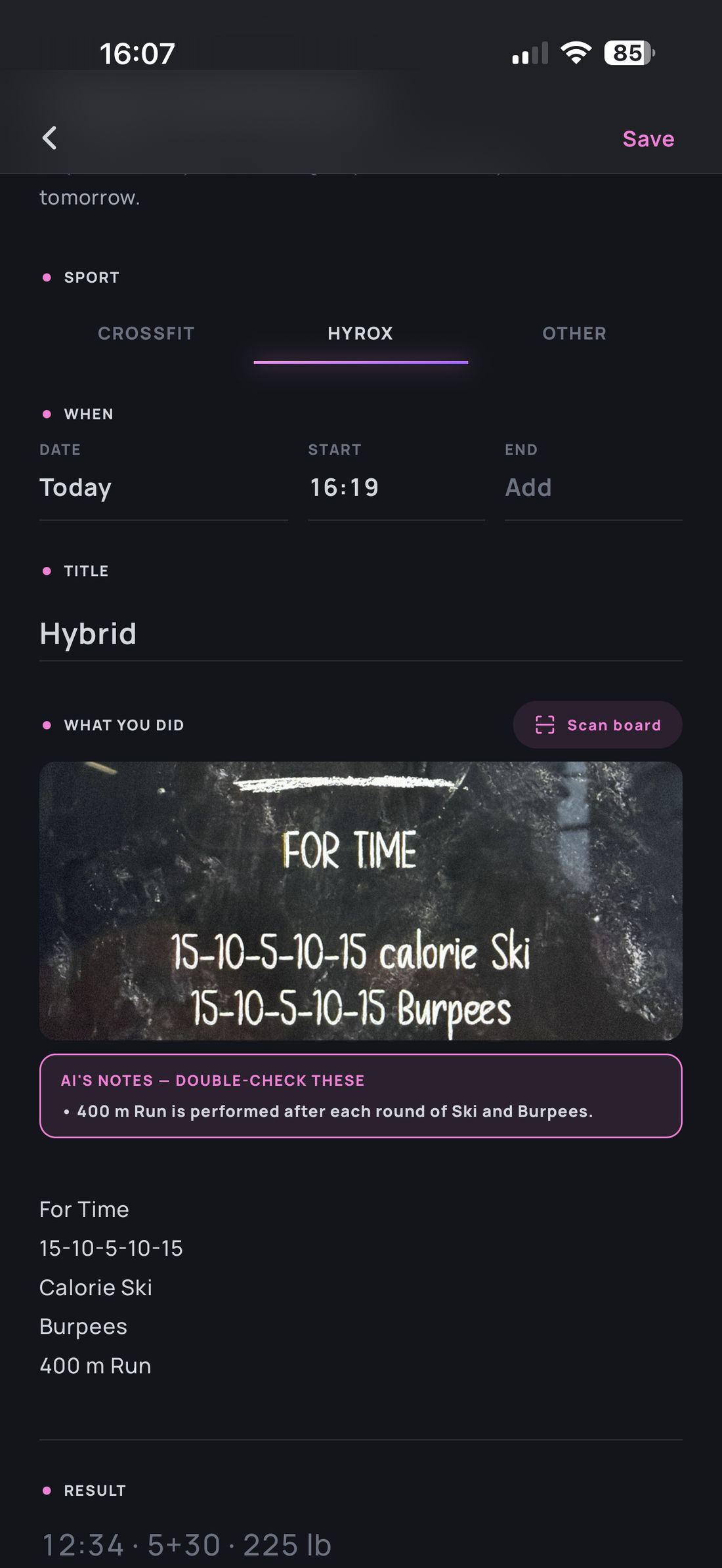
Type it, pick a benchmark, or photograph the whiteboard and let it read the scrawl. Fran, a HYROX sim, or whatever your coach put up this morning.
02
The band records the whole session on its own — through the run, the rower, the sled. No screen to glance at, nothing to tap between rounds.
03
Because it knew the workout, it can find the workout in what it measured — every rep, every round, and every one of the gaps in between.
04 — What comes back
Not because the sensors are exotic — because it knew what you were doing while it measured.
01
Thrusters, pull-ups and the run scored separately instead of averaged into one number. You will recognise the one that is eating your score.
02
The sixty seconds after a set say more about fitness than the sixty during it. Vitroo watches every one of them and shows the curve getting flatter as you tire.
03
Rep speed, round by round. The moment your pace broke is a place on a chart, not a feeling you half remember on the drive home.
04
Eight runs, eight stations, and the roxzone nobody trains. Fixed format means your splits are comparable to every other race you have ever run.
05 — The read
None of this is a dashboard of everything it captured. Each one answers a question an athlete actually asks out loud.
Bar speed
Point the camera at the lift. A standard bumper is 450 mm across, and that is the only known length in the picture — so the plate itself is the ruler, and no calibration is asked of you.
Off-axis the plate is an ellipse rather than a circle, so vertical travel is measured against its vertical semi-axis and horizontal travel against the horizontal one. Using one radius for both is not a small error, and it is the reason most phone trackers disagree with a linear transducer.
What comes back is a bar path and a velocity curve per rep — and the clip leaves your phone with the plot drawn into the video, frame by frame.
Zone 2
A Zone 2 session fails the same way every time: you drift up on a hill and stay there for ten minutes before you notice. A correction is only useful while it is still happening.
But heart rate is noisy enough that a bare "above the band" test fires constantly at the boundary — and a cue that fires constantly is one you learn to ignore. So a reading has to clear the band by a margin, then persist, before it earns a word. And it has to be corrected for a while before the drift is over.
Sleep
The night is divided the way you would recognise it: when you fell asleep, how the stages split it, how much of the time in bed you were actually asleep.
What it will not do is mark you down for a stage the hardware cannot see. A band running an older staging algorithm reports no REM at all — scoring that night against a textbook would be scoring the firmware, not the sleep. Any component the night has no evidence for is dropped and the rest re-weighted.
A gap in the record is drawn as a gap. Nothing is inferred through it.
Load
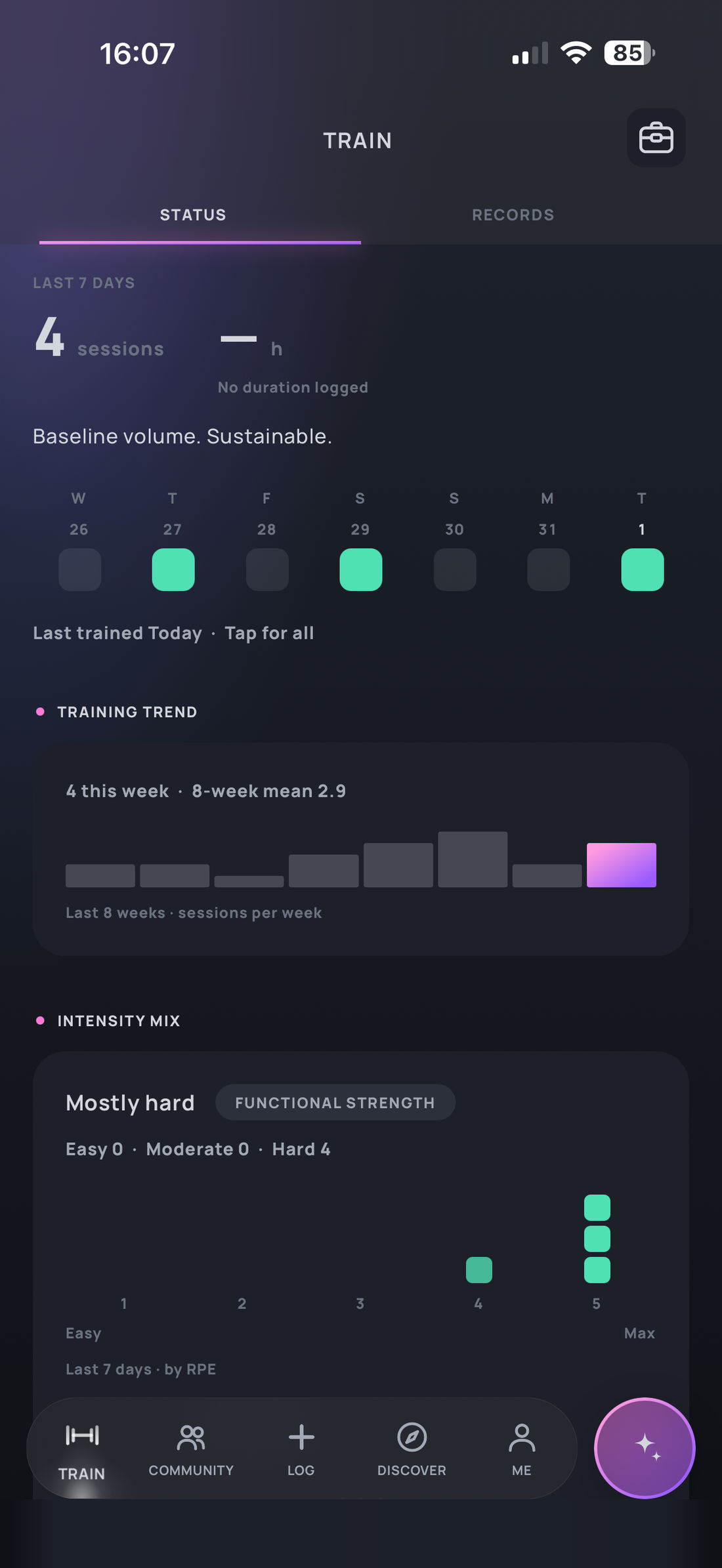
A consecutive-day counter is an actively misleading number in CrossFit and HYROX. It rewards overtraining and ignores the half of periodisation that makes the other half work.
So the number on the front is trailing seven-day volume with a status attached — fresh, easing, solid, heavy, high — in the language a coach actually uses. The thresholds lean toward rest as the load climbs.
Hard days are counted by your exertion rating, not by session count. Three easy sessions are not a hard day, and a day with no rating still reads as trained, because that you trained is a fact and how hard is simply unknown.
Vitroo Read
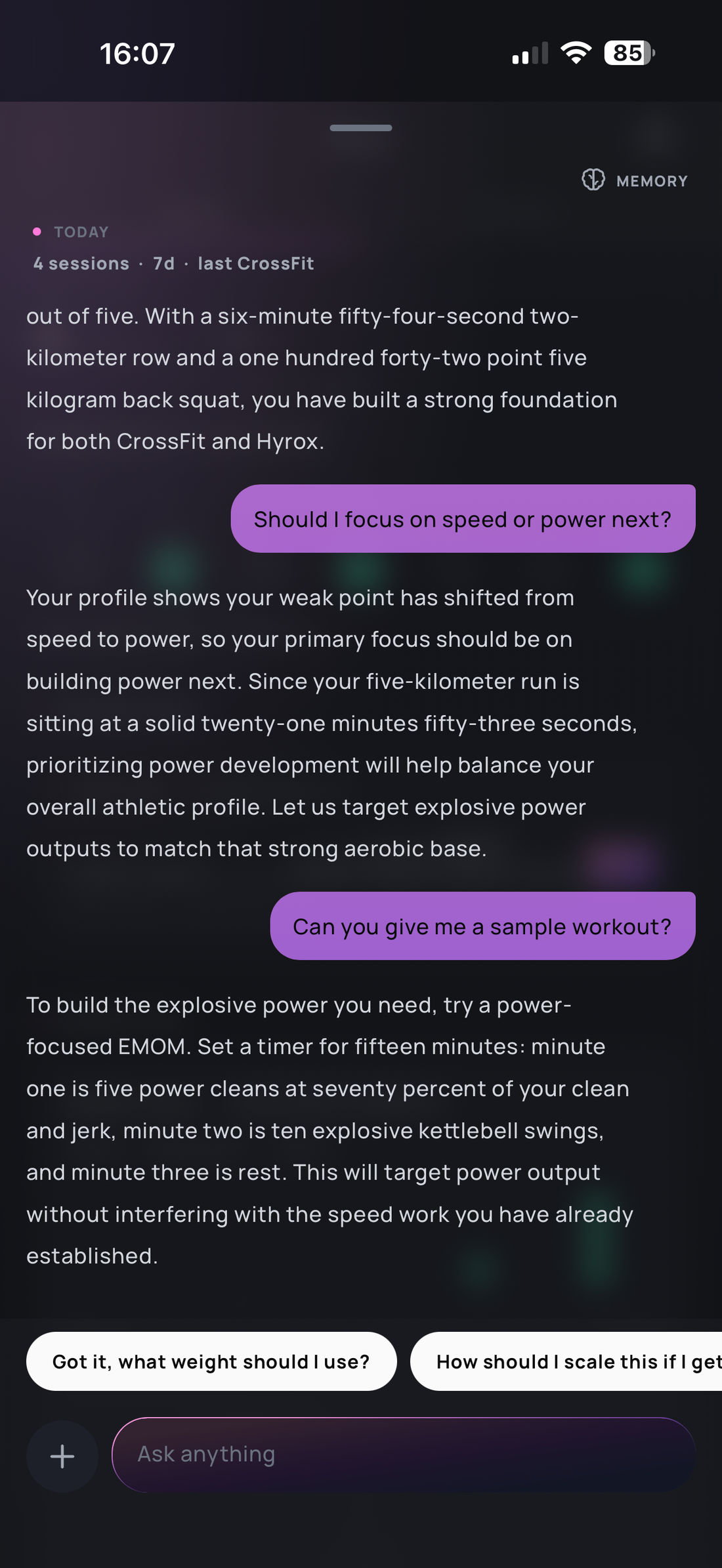
Ask it anything and the answer is grounded in the sessions you logged — your 2 km row, your back squat, the fact that your weak point moved from speed to power two months ago.
It is not a chatbot bolted onto a tracker. It reads the same axes, the same benchmarks and the same recovery curves the rest of the app does, which is why it can answer "should I focus on speed or power next" with a reason instead of a platitude.
Should I focus on speed or power next?
Your profile shows your weak point has shifted from speed to power, so your primary focus should be on building power next. Since your five-kilometre run is sitting at a solid 21:53, prioritising power development will help balance your overall athletic profile.
06 — In the app
The band has no screen, so this is the whole interface. It is built to be read in the ninety seconds after you rack the bar.
07 — Two sports
That is not a small detail — it is the whole reason this works. A general fitness tracker cannot ask you what you are about to do, because most of the people wearing one are not about to do anything in particular. You are.
CrossFit
The benchmarks do not move, so neither does the comparison. Vitroo lines this Fran up against your last one rep for rep — and against the recovery between rounds, which is the half of your fitness the clock never showed you.
Every round you finish, it watches the sixty seconds afterwards. When the curve stops coming back down, that is the round that beat you.
HYROX
The format never changes, which makes your splits comparable to every race you have ever run and to everyone you will ever line up against. Vitroo scores each station on its own, and it scores the roxzone — the transitions nobody trains and everybody loses time in.
08 — Records
Five families of personal best and two catalogues of benchmark, each scored the way its own sport scores it — fastest, heaviest, most unbroken, or simply first.
Running · time
1K · 5K · 10K · Half · Marathon
Engine · time
Row and SkiErg at 500 m, 1K, 2K
Strength · load
Back Squat · Front Squat · Deadlift · Press · Bench
Weightlifting · load
Clean · Jerk · Snatch · Power Clean · Power Snatch
Gymnastics · first & unbroken
Seven skills, scored twice — the day you first got one, and the most you have ever strung together
Benchmarks
The CrossFit Girls, the HYROX PFT, the eight stations and the runs — for time, or by rounds and remainder
09 — The band
No screen, no notifications, nothing to swipe. It is a sensor you stop noticing by the second day — which is the only way a thing gets worn for the night as well as the session.
10 — Why not a watch
Nothing here is about better sensors. It is about the one piece of information every other device on your wrist is missing.
| Vitroo | Sports watch | Fitness tracker | |
|---|---|---|---|
| Knows the workout before it starts | |||
| Scores each movement separately | |||
| Recovery between rounds, not just after | |||
| Rep speed and bar path | |||
| HYROX scored station by station | lap button | ||
| Heart rate, sleep, daily load | |||
| Nothing to look at mid-workout | sometimes |
11 — Membership
One membership: the hardware, the analysis, and every new thing we ship. No upfront cost for the band, and it gets replaced if we make a better one.
Monthly
¥89/month
Rolling. Stop whenever you like.
Annual · best value
¥59/month
¥708 billed once — two months free.
Gyms & teams
Talk to us
Five athletes or five hundred.
In every plan · nothing is held back for a higher tier
Ships in mainland China today. iOS app included; Android is in progress.
12 — Questions
Yes, and it takes about thirty seconds — type it, pick a benchmark from the catalogue, or photograph the whiteboard. That one habit is the entire difference between this and every other band. Without it there is nothing to find in the signal; with it, the band knows the second round of thrusters from the first.
The band still records the session — heart rate, movement, the whole day. What you get back is the curve everyone else's tracker gives you, which is the thing this whole page is about not settling for. Logging it late is better than not at all; logging it first is the point.
No. It records a full day on its own and syncs when the two are next near each other. Leave the phone in the bag — that is what the thing is for.
Yes. 50 m water resistant, and it is meant to stay on for the shower and the sauna too. Taking it off is how a band stops being worn.
About once a month. 21 days on a charge is the target, and the reason for it is behavioural rather than technical: a band you charge nightly is a band that is off your wrist every night, which is exactly when it should be reading you.
CrossFit or HYROX. Both work because both are written down before they are performed, which is what makes a prior available. General training still gets heart rate, sleep and load — it just cannot get the movement-level read, because nothing told it what the movements were.
In progress. iOS today.
It is yours, and what we keep and why is written out in full rather than summarised here — see the privacy policy. You can delete your account from inside the app.
13 — Who we are
Recognising movement from a wrist is not a solved problem, and everyone who has tried to solve it in general has failed. We do not solve it in general. We ask you what you are about to do, and then we only have to find it — which is a problem that has an answer.
That is the whole company: sensors, signal, and a sport with enough structure to be worth measuring properly. If that is the kind of thing you want to work on — hardware, firmware, signal processing, iOS — we would like to hear from you.
From ¥59/month · band included · cancel anytime